A cathedral that tells Siena's whole story
Stone by stone, chapel by chapel, the Duomo reveals how art, politics, devotion, and rivalry built one of Italy's most compelling sacred spaces.
Table of Contents
From medieval Siena to a grand cathedral project
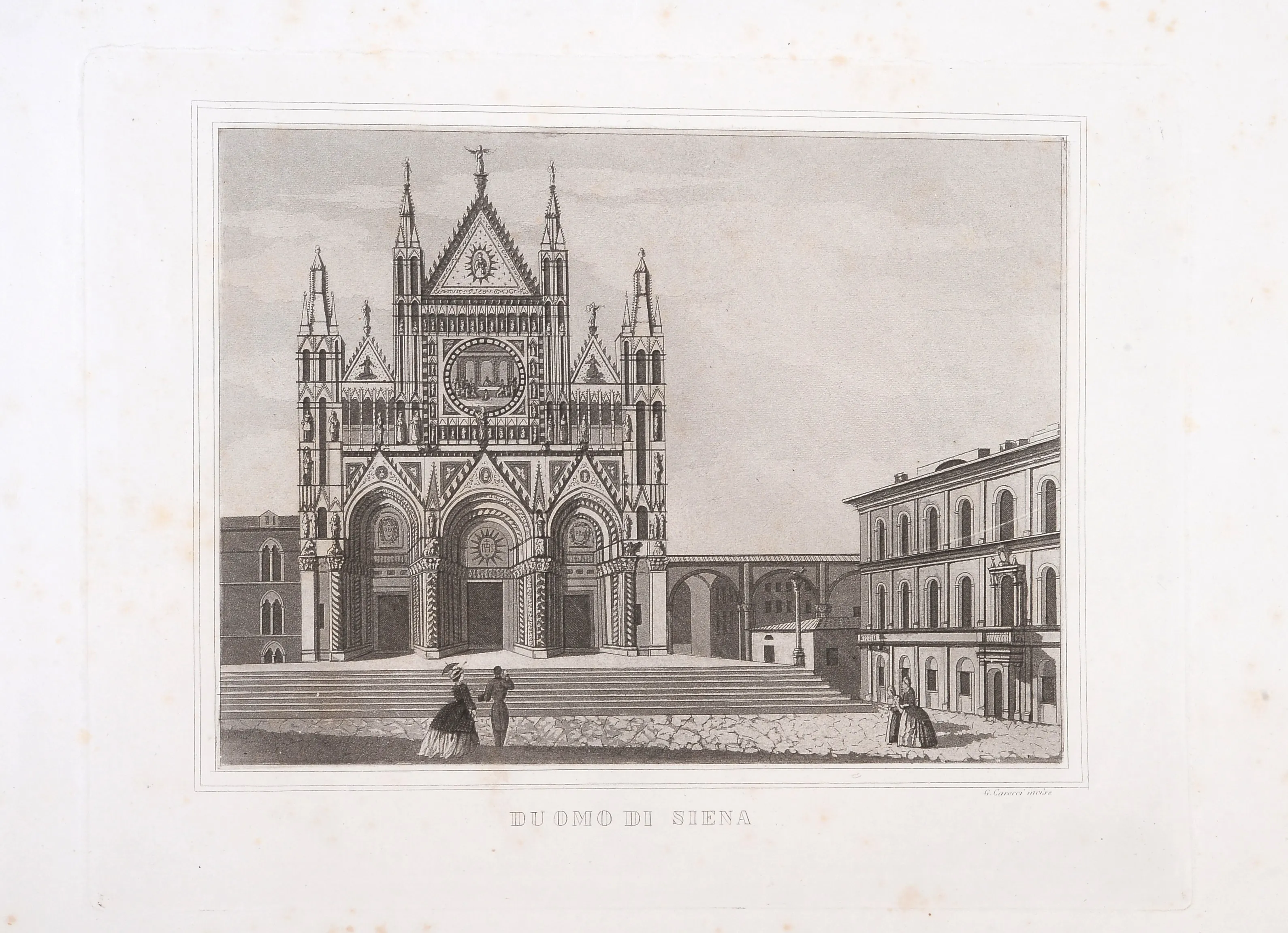
To understand the Duomo di Siena, it helps to begin with the city itself: a medieval republic that was wealthy, competitive, and fiercely proud. In the High Middle Ages, Siena grew through banking, trade routes, and political influence, and like many Italian communes, it translated civic ambition into stone. A cathedral was not only a place of worship but also a statement of identity, power, and collective confidence. The site that became today's Duomo evolved over time, with phases of expansion and redesign that reflected changing artistic language and the city's desire to stand alongside, or even above, regional rivals.
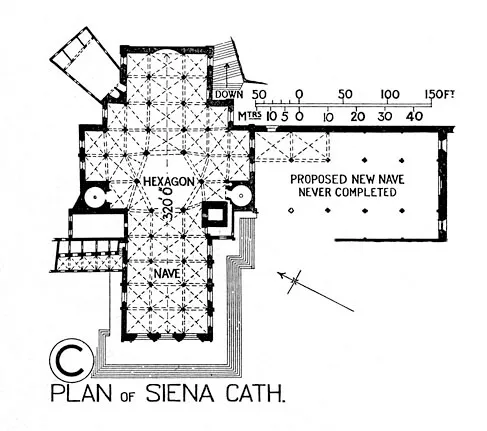
By the 13th and 14th centuries, Siena envisioned a cathedral of extraordinary scale, and plans became increasingly ambitious. The most daring idea was to transform the existing church into just one arm of a much larger New Cathedral, a project that, if completed, would have ranked among Europe's most monumental sacred buildings. History, however, intervened: economic pressures, political shifts, and the devastating Black Death altered the city's trajectory. What remains is both complete and incomplete at once, and that paradox is part of the Duomo's emotional force: it is a masterpiece, but also a visible record of unrealized dreams.
Facade, marble stripes, and symbolic identity
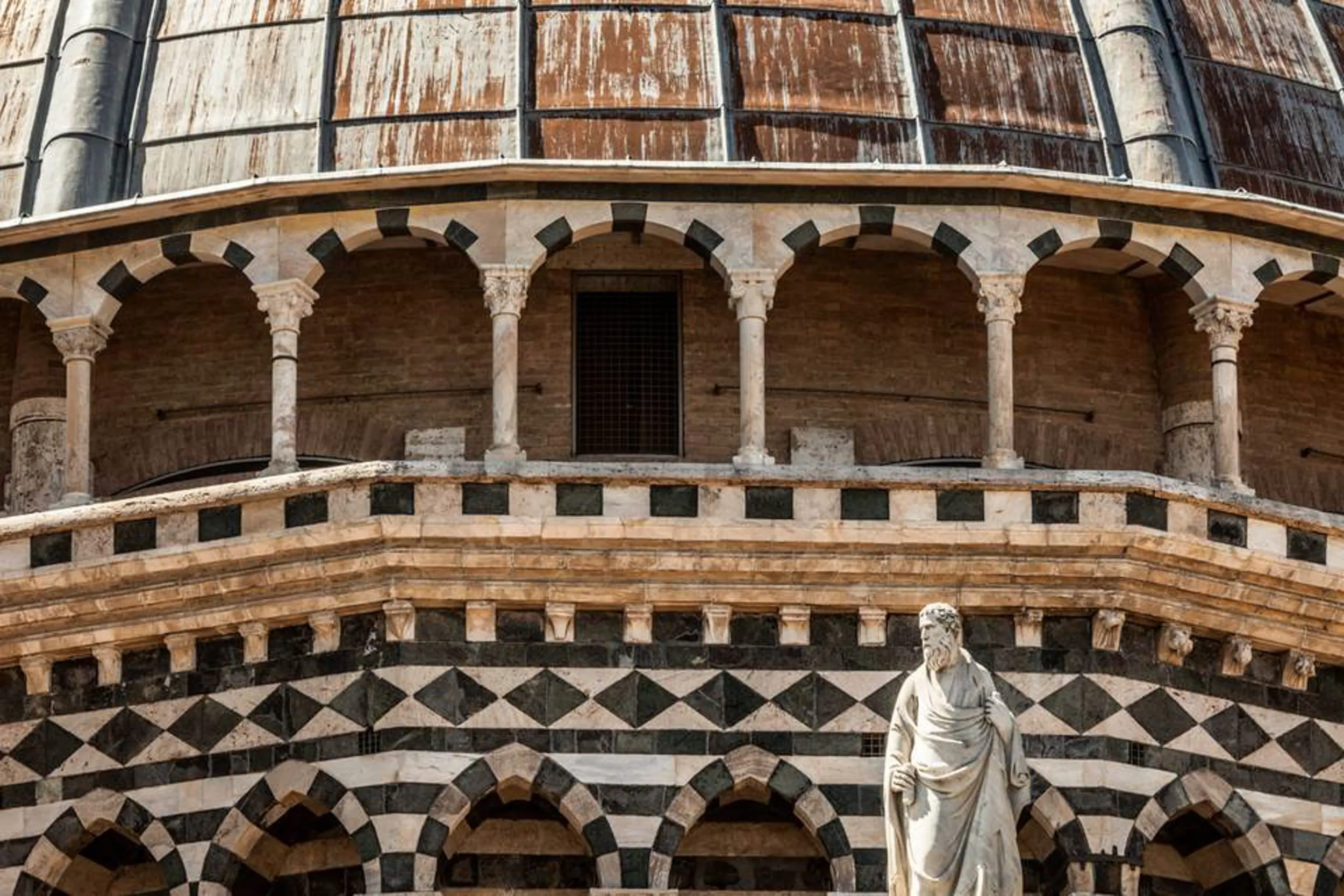
The first encounter with the Duomo is often the facade, and it feels almost theatrical: layered sculpture, pointed Gothic lines, and a luminous contrast of white, dark green, and pinkish marble details depending on the light. Siena's black and white striping is more than decoration. Traditionally linked to the city's legendary founders, the colors became a civic symbol repeated throughout architecture and heraldry. At the cathedral, that language reaches full expression, turning structure into visual identity.
Look closely and the facade reveals a conversation across centuries. Gothic ambition sits beside later interventions, and decorative richness coexists with geometric discipline. This blending is one of Siena's signatures: continuity without uniformity. Many visitors initially read the building as simply beautiful, then gradually notice how every zone communicates hierarchy and meaning, from portal sculpture to rose windows and from banded columns to carved details that guide the eye upward.
The nave, pulpit, and artistic patronage
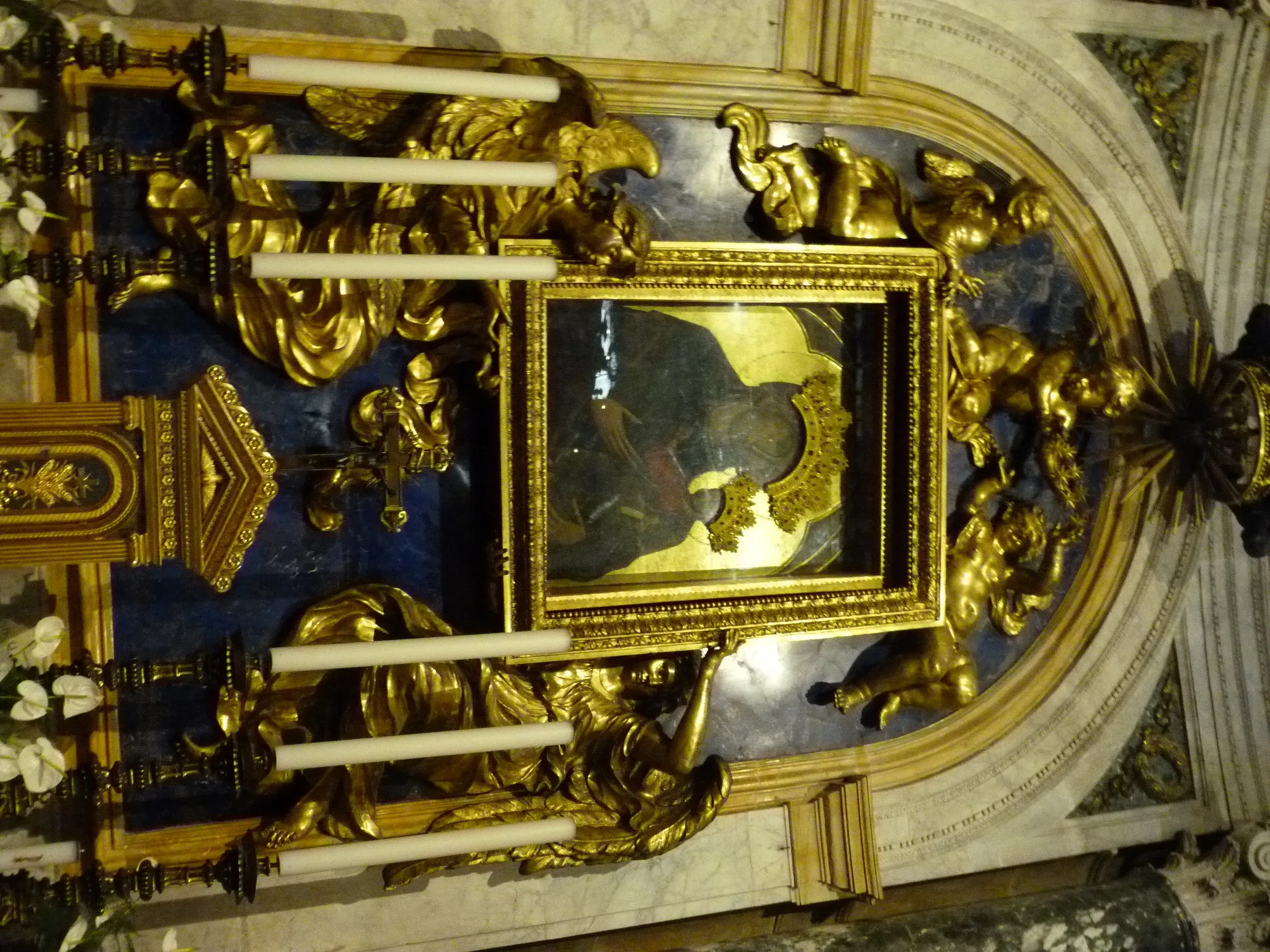
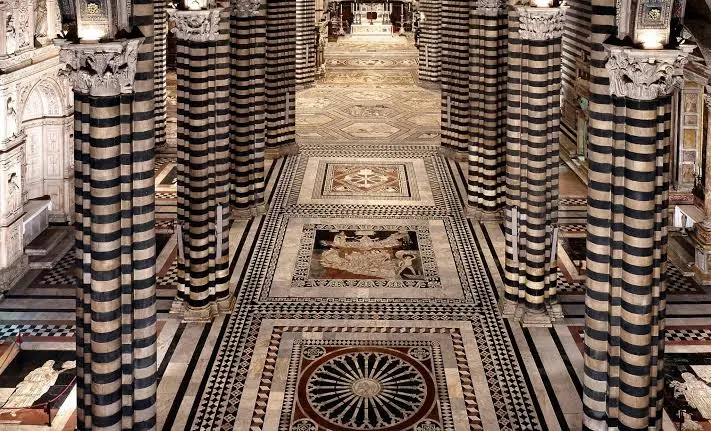
Inside the cathedral, the rhythm of alternating marble bands creates an unmistakable atmosphere: solemn yet dramatic, ordered yet alive. As light moves through the day, surfaces shift from cool clarity to warmer tones, and the space seems to breathe. The nave leads visitors through a sequence of visual anchors, each tied to liturgy, patronage, and the city's cultural ambitions. Siena did not commission art casually; each major work participated in a broader narrative about faith, civic legitimacy, and intellectual prestige.
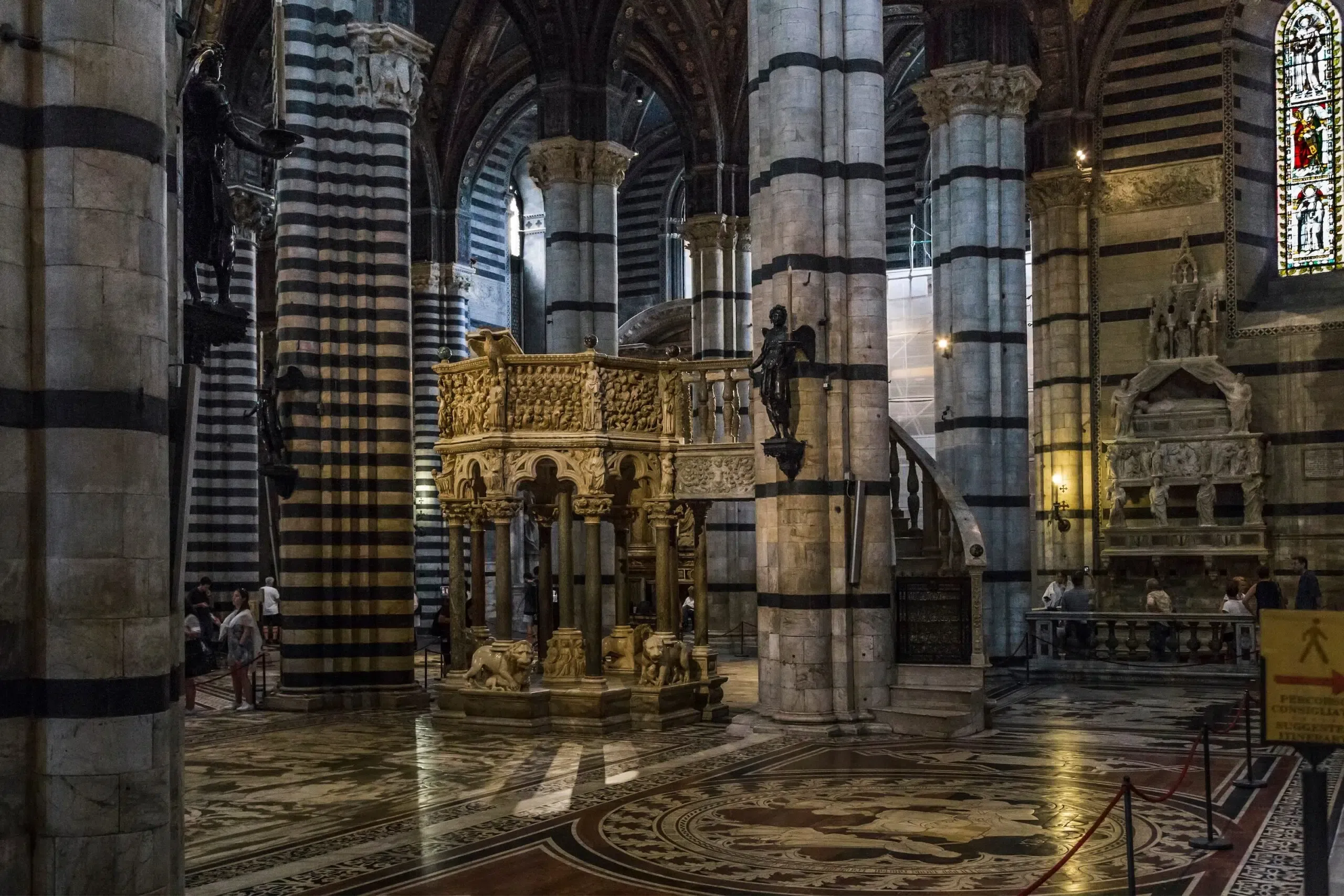
One of the most celebrated features is Nicola Pisano's pulpit, an extraordinary sculptural achievement where biblical scenes unfold with emotional intensity and classical influence. It is the kind of work that rewards slow looking: faces, gestures, drapery, and compositional movement reveal themselves layer by layer. Even for visitors without specialist knowledge, the effect is immediate. You sense that this is not only a religious object but a milestone in the development of Italian sculpture.
Libreria Piccolomini and Renaissance storytelling
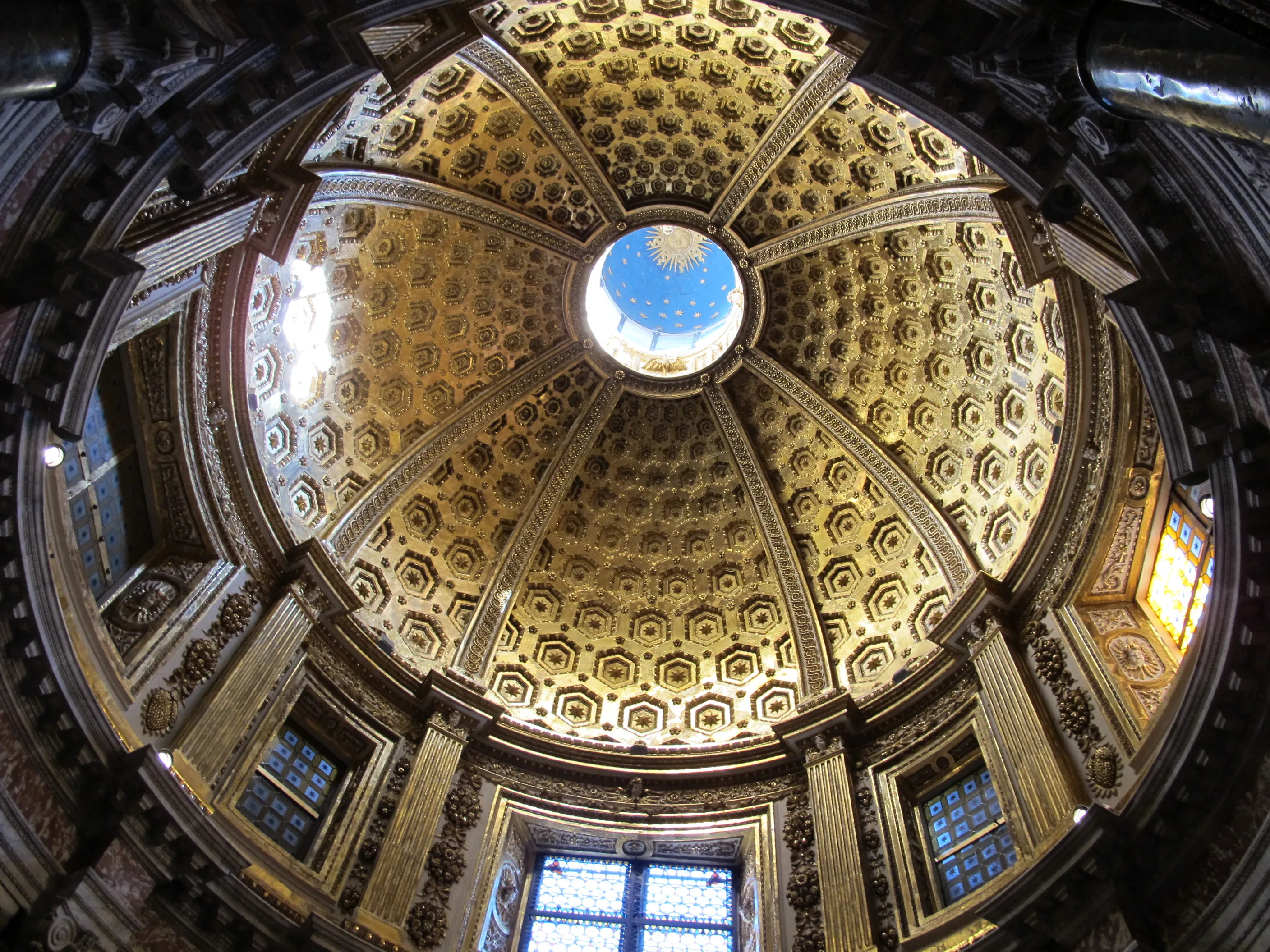
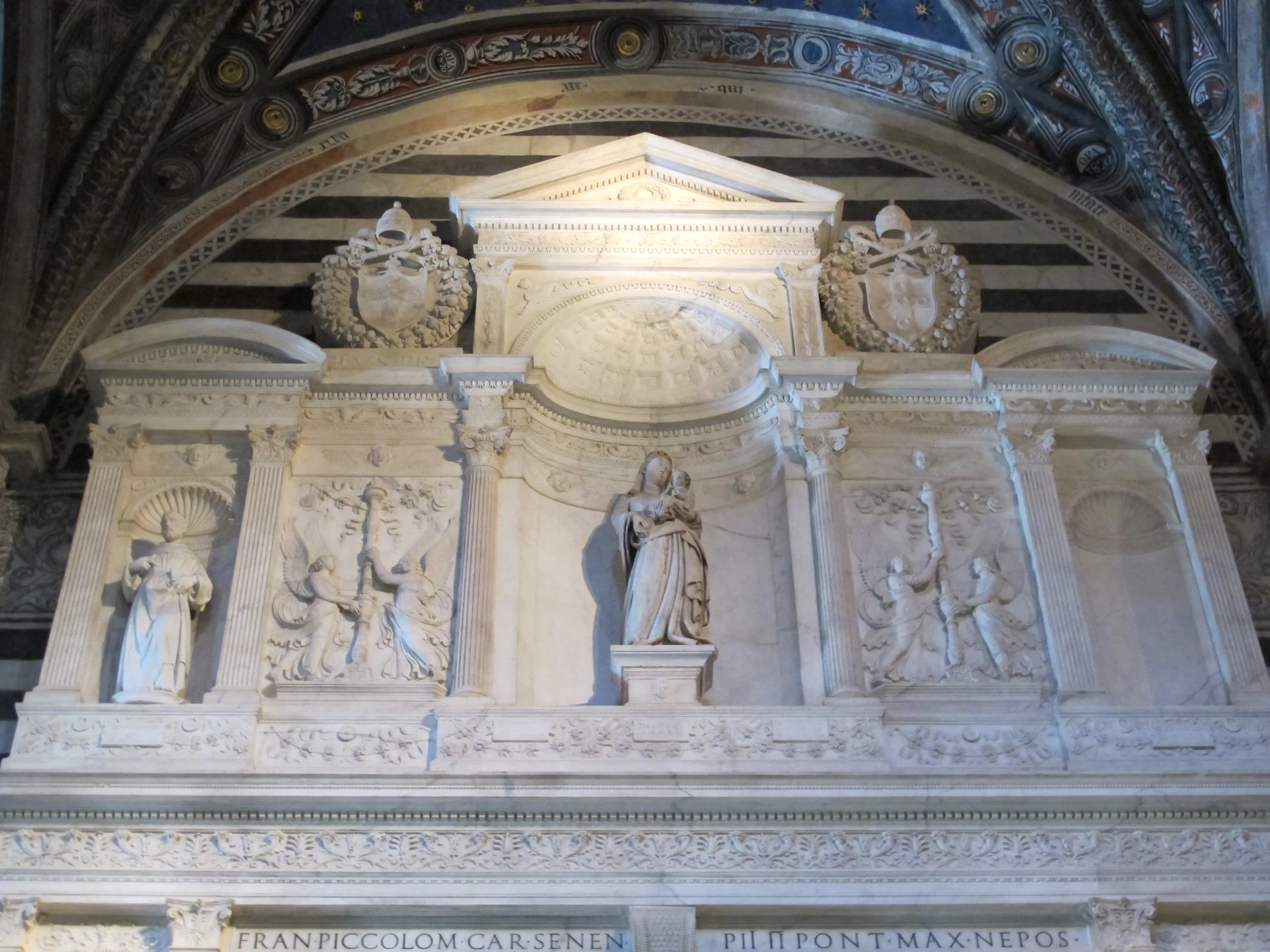
The Libreria Piccolomini often surprises visitors because its colors feel almost freshly painted. Built to honor Pope Pius II Piccolomini, the library houses rich fresco cycles, luminous decorative schemes, and precious choir books that reflect both religious devotion and humanist learning. In this room, the Renaissance speaks in full voice: biography, symbolism, prestige, and visual storytelling merge into one coherent experience.
Take your time with the details. The scenes are crowded with architectural backdrops, ceremonial moments, and expressive figures that reveal how patronage worked in late medieval and Renaissance Italy. Beyond beauty, the library communicates memory: how powerful families shaped public narratives through art, and how a cathedral could become a repository not only of worship but of intellectual and political history.
The inlaid floor: theology, politics, and wonder
Siena Cathedral's floor is among the most extraordinary in Europe: a vast program of marble inlay and graffiti technique developed by numerous artists over centuries. Rather than a single decorative carpet, it is a visual encyclopedia of biblical episodes, Sibyls, virtues, allegories, and moral lessons. Some panels are normally protected and uncovered only in specific periods, which makes timing your visit particularly rewarding.
The floor's power lies in its complexity. It invites theological reading, civic interpretation, and pure aesthetic admiration all at once. Certain scenes reflect medieval and Renaissance worldviews where sacred history and civic identity are deeply connected. Standing above these images, visitors often feel an unusual tension: you are walking on a masterpiece that was designed not to dominate from afar, but to reveal itself gradually under your own movement.
Baptistery, Crypt, and the hidden layers below
Beyond the main nave, the Baptistery and Crypt deepen the experience by revealing spaces that many first time visitors underestimate. The Baptistery combines architecture, painted decoration, and sculptural works connected to the sacrament of baptism and communal religious life. It feels intimate compared to the cathedral, yet artistically dense and historically resonant.
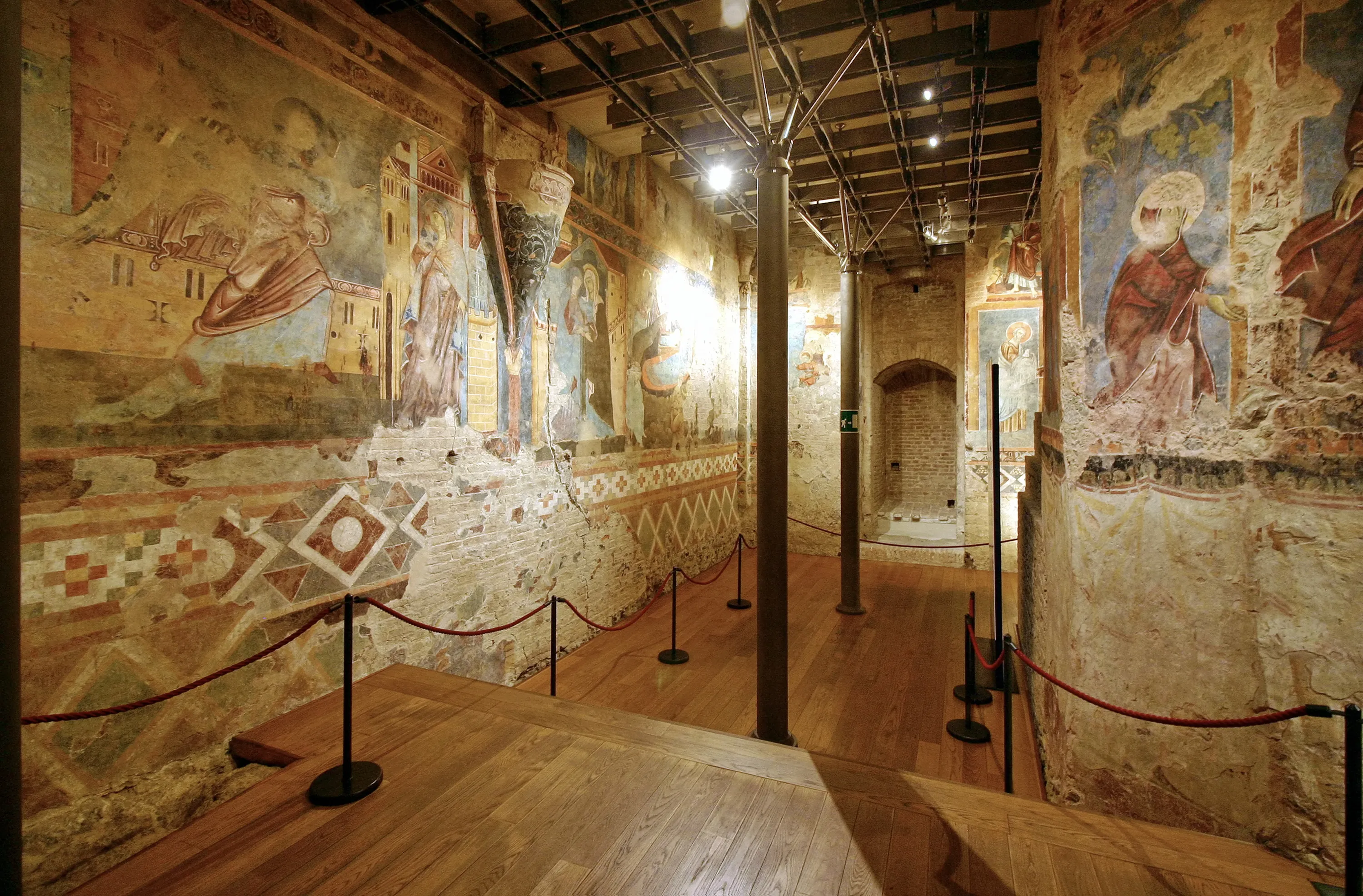
The Crypt, rediscovered in modern times, offers another striking perspective: preserved frescoes and surfaces that reconnect you to earlier phases of the cathedral's evolution. Descending into these spaces can feel like moving backward through layers of time. You begin to sense the Duomo not as a fixed monument but as a living construction site across centuries, where additions, changes, and rediscoveries continually reshape understanding.
Museo dell'Opera and masterpieces preserved
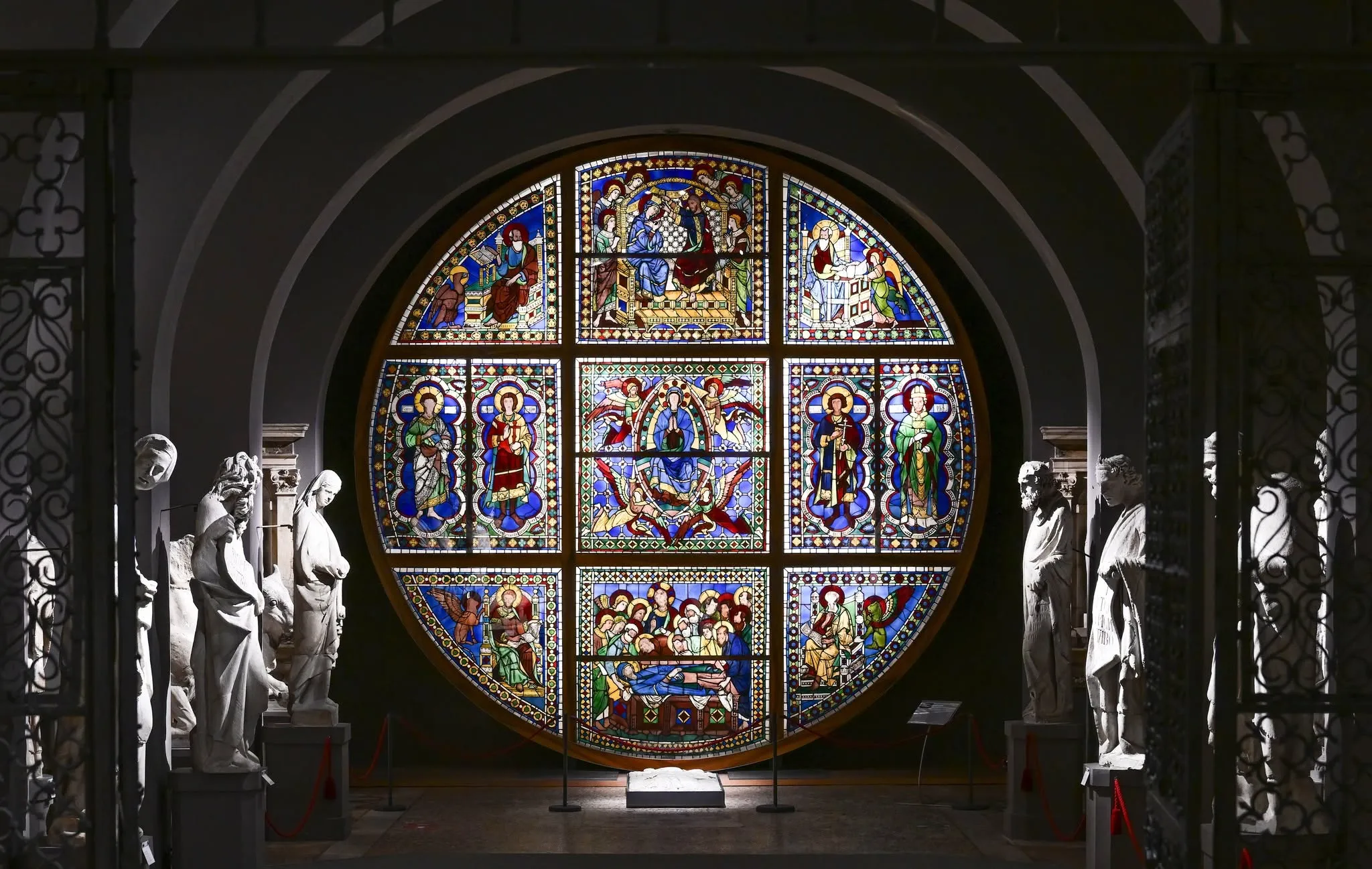
The Museo dell'Opera del Duomo is essential for understanding the cathedral in full. Here, original works that once faced weather and liturgical wear can be appreciated up close in controlled conditions. The museum context allows details to emerge that are hard to read on exterior facades or high architectural positions, and it clarifies how the complex developed artistically over time.
Many visitors discover in the museum that the Duomo experience is not only about one spectacular interior but about a network of objects, commissions, and narratives spread across connected spaces. Seen together, sculpture, painting, and architectural fragments become evidence of Siena's long cultural investment. The result is richer than a standard monument visit: it feels like stepping into a city's artistic memory archive.
The unfinished New Cathedral and the Facciatone
One of Siena's most fascinating stories is visible in brick and stone around the complex: the unfinished expansion known as the New Cathedral. The project aimed to enlarge the existing Duomo dramatically, but historical crises halted construction. What survives today, including towering structural elements and the celebrated Facciatone viewpoint, is a rare architectural what-if preserved in plain sight.
Climbing the Facciatone is more than a photo stop. It gives visitors a spatial understanding of Siena's medieval urban form and of the sheer ambition behind the unrealized plan. From above, you can read the city as a dense fabric of contrade, rooftops, towers, and ridgelines. It is one of those moments where historical imagination and physical landscape align perfectly.
Plague, resilience, and changing priorities
No history of the Duomo can ignore the 14th century catastrophe of plague, which transformed Siena demographically, economically, and spiritually. The interruption of major building ambitions was not merely technical; it reflected a society forced to recalculate its future after immense loss. Yet the city did not abandon artistic investment. Instead, priorities shifted from expansion to preservation, refinement, and selective completion.
This resilience is written into the monument itself. You can sense phases of confidence, crisis, adaptation, and renewal embedded in architecture and decoration. For modern visitors, this continuity through rupture gives the Duomo unusual emotional depth. It is not frozen perfection but a truthful historical body that carries both triumph and vulnerability.
From devotion to destination: modern visiting culture
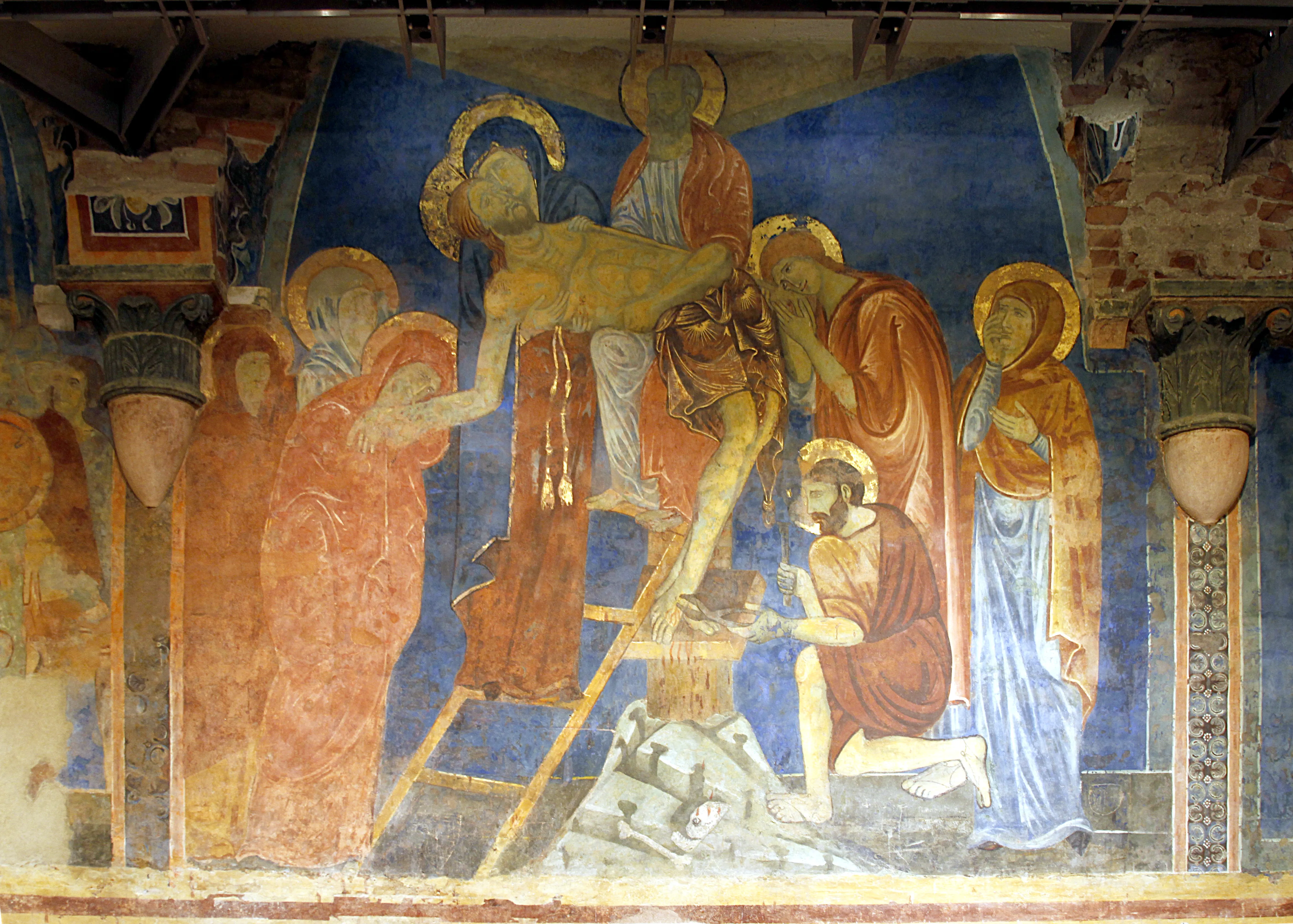
Today the Duomo serves multiple audiences at once: worshippers, art lovers, architecture students, families, and day trippers moving through Tuscany. This dual identity requires careful management of entries, conservation, and interpretation. Modern ticket systems and timed flows are not just logistical tools; they are part of preserving a fragile and heavily visited heritage environment.
For visitors, this means planning matters. A little preparation turns the experience from rushed sightseeing into meaningful encounter. Choosing the right pass, arriving at a smart hour, and prioritizing sections based on your interests can dramatically improve the quality of your visit. The Duomo rewards depth more than speed.
Conservation, restoration, and fragile beauty
The Duomo's beauty can make it seem timeless, but every surface is vulnerable: marble responds to humidity and touch, pigments react to light, and structural materials age continuously. Conservation at Siena is therefore an ongoing process rather than a one time intervention. Specialists monitor, clean, stabilize, and document works so that future generations can encounter them with integrity.
Visitors play a real role in this process. Respecting barriers, avoiding flash where prohibited, and following staff instructions help protect irreplaceable art. When people understand that preservation is active and costly, the monument becomes more than a backdrop for photos. It becomes a shared responsibility, and that awareness can deepen the visit in unexpected ways.
Interesting facts many visitors miss
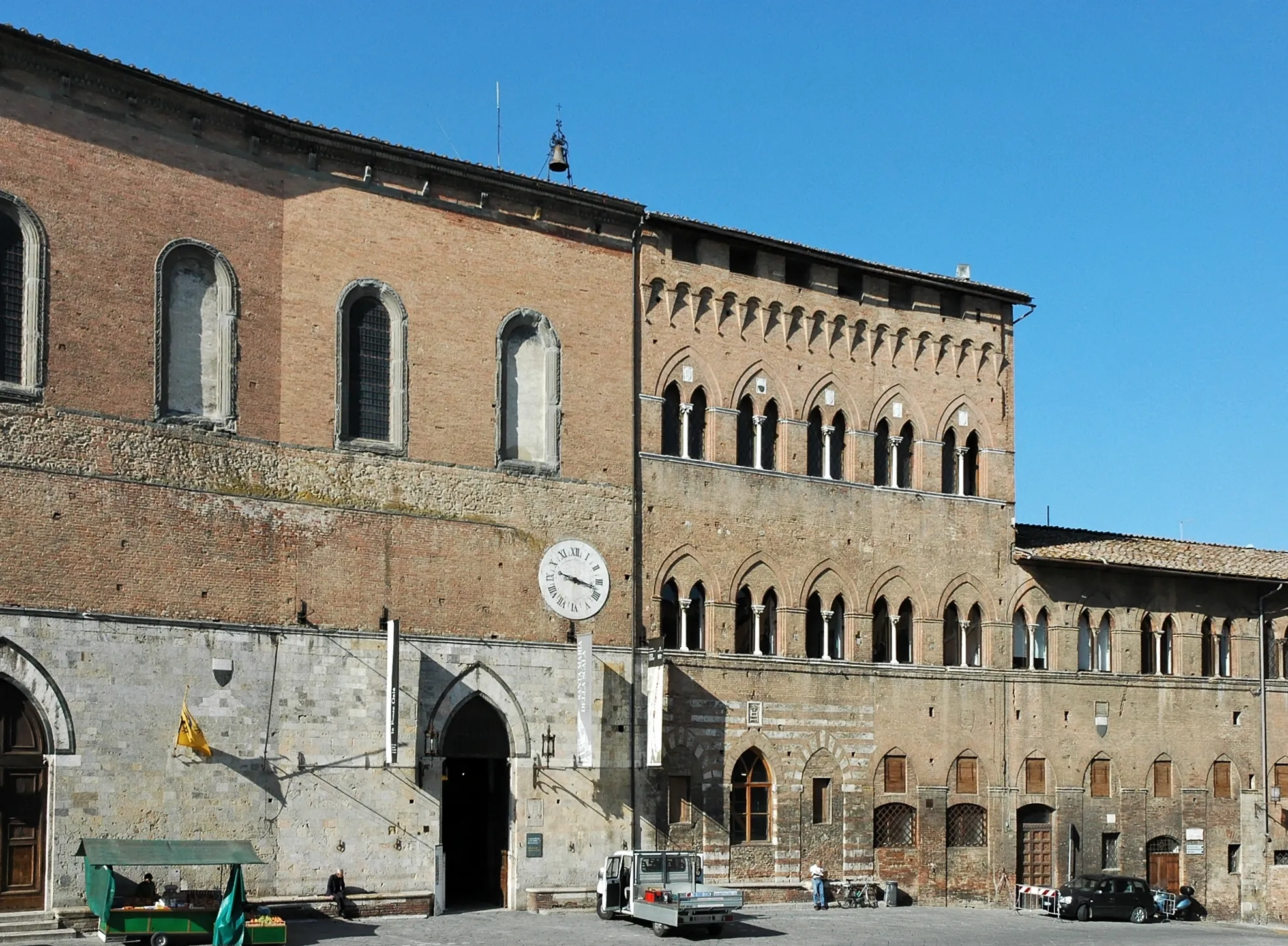
A few details are worth watching for because they often escape first time visitors: the she-wolf symbol tied to Siena's founding legend, the recurring black and white palette linked to civic identity, and the way floor imagery guides moral reflection as much as decoration. Many people also do not realize that parts of the floor are uncovered only seasonally, which can completely change the experience.
Another fascinating point is how unfinished architecture became one of the site's strongest attractions. The Facciatone exists because a grand plan stopped mid course, yet that interruption now offers one of the city's best viewpoints. In Siena, incompletion is not failure; it is historical evidence. The Duomo teaches this beautifully.
Why the Duomo still feels profoundly alive
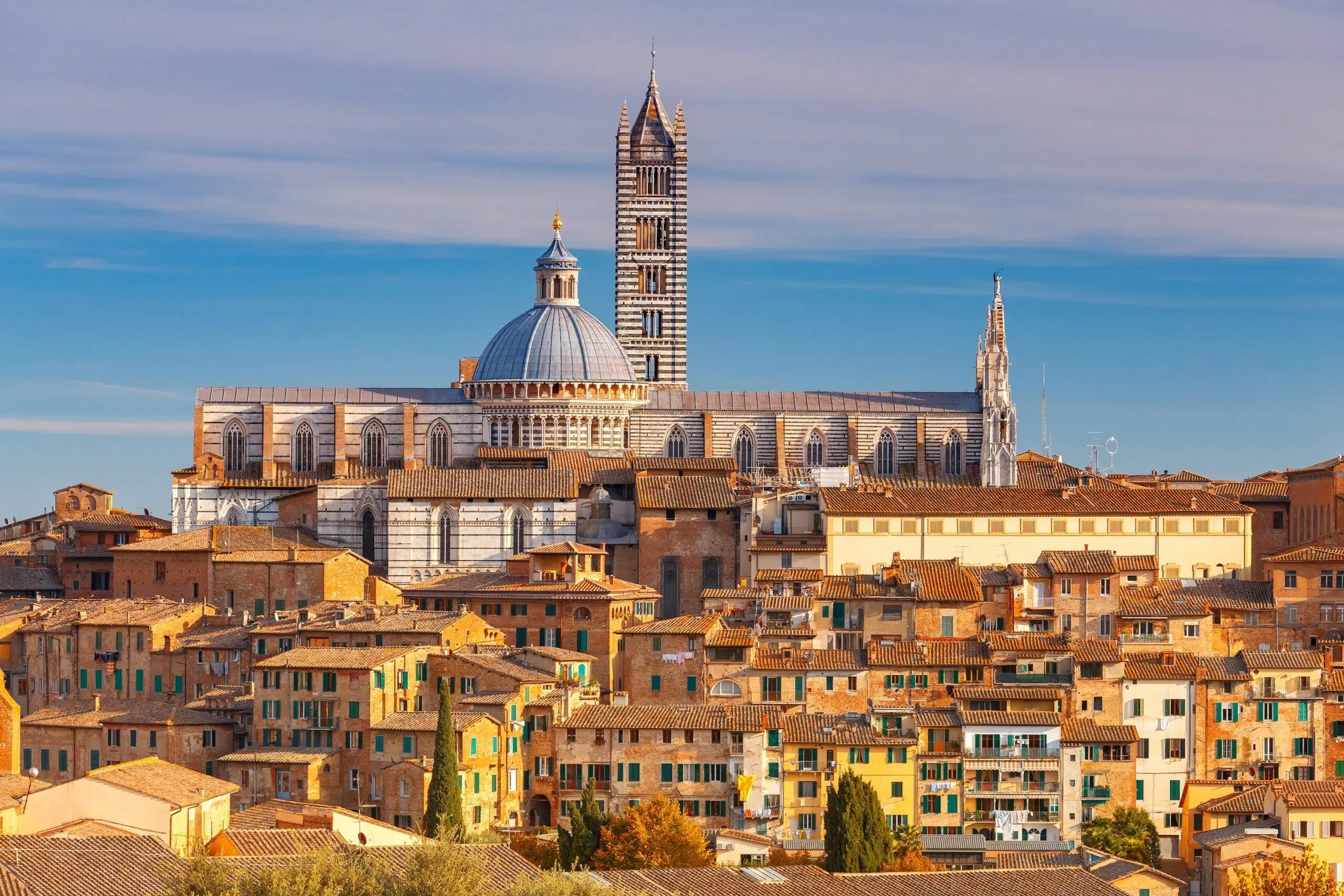
The Duomo di Siena remains powerful because it is not experienced as a single style, period, or message. It is a layered organism where medieval aspirations, Renaissance intellect, devotional practice, civic symbolism, and modern conservation all coexist. Visitors sense this complexity intuitively, even before they can name each artist or date each phase.
By the time you leave, the memory is usually composite: marble patterns underfoot, chapel shadows, brilliant fresco colors, and the open panorama from the Facciatone. Together they create something rare in contemporary travel, a monument that feels both grand and personal. The Duomo does not just show Siena's history. It invites you to walk through it slowly, attentively, and with genuine wonder.
Table of Contents
From medieval Siena to a grand cathedral project
To understand the Duomo di Siena, it helps to begin with the city itself: a medieval republic that was wealthy, competitive, and fiercely proud. In the High Middle Ages, Siena grew through banking, trade routes, and political influence, and like many Italian communes, it translated civic ambition into stone. A cathedral was not only a place of worship but also a statement of identity, power, and collective confidence. The site that became today's Duomo evolved over time, with phases of expansion and redesign that reflected changing artistic language and the city's desire to stand alongside, or even above, regional rivals.
By the 13th and 14th centuries, Siena envisioned a cathedral of extraordinary scale, and plans became increasingly ambitious. The most daring idea was to transform the existing church into just one arm of a much larger New Cathedral, a project that, if completed, would have ranked among Europe's most monumental sacred buildings. History, however, intervened: economic pressures, political shifts, and the devastating Black Death altered the city's trajectory. What remains is both complete and incomplete at once, and that paradox is part of the Duomo's emotional force: it is a masterpiece, but also a visible record of unrealized dreams.
Facade, marble stripes, and symbolic identity
The first encounter with the Duomo is often the facade, and it feels almost theatrical: layered sculpture, pointed Gothic lines, and a luminous contrast of white, dark green, and pinkish marble details depending on the light. Siena's black and white striping is more than decoration. Traditionally linked to the city's legendary founders, the colors became a civic symbol repeated throughout architecture and heraldry. At the cathedral, that language reaches full expression, turning structure into visual identity.
Look closely and the facade reveals a conversation across centuries. Gothic ambition sits beside later interventions, and decorative richness coexists with geometric discipline. This blending is one of Siena's signatures: continuity without uniformity. Many visitors initially read the building as simply beautiful, then gradually notice how every zone communicates hierarchy and meaning, from portal sculpture to rose windows and from banded columns to carved details that guide the eye upward.
The nave, pulpit, and artistic patronage
Inside the cathedral, the rhythm of alternating marble bands creates an unmistakable atmosphere: solemn yet dramatic, ordered yet alive. As light moves through the day, surfaces shift from cool clarity to warmer tones, and the space seems to breathe. The nave leads visitors through a sequence of visual anchors, each tied to liturgy, patronage, and the city's cultural ambitions. Siena did not commission art casually; each major work participated in a broader narrative about faith, civic legitimacy, and intellectual prestige.
One of the most celebrated features is Nicola Pisano's pulpit, an extraordinary sculptural achievement where biblical scenes unfold with emotional intensity and classical influence. It is the kind of work that rewards slow looking: faces, gestures, drapery, and compositional movement reveal themselves layer by layer. Even for visitors without specialist knowledge, the effect is immediate. You sense that this is not only a religious object but a milestone in the development of Italian sculpture.
Libreria Piccolomini and Renaissance storytelling
The Libreria Piccolomini often surprises visitors because its colors feel almost freshly painted. Built to honor Pope Pius II Piccolomini, the library houses rich fresco cycles, luminous decorative schemes, and precious choir books that reflect both religious devotion and humanist learning. In this room, the Renaissance speaks in full voice: biography, symbolism, prestige, and visual storytelling merge into one coherent experience.
Take your time with the details. The scenes are crowded with architectural backdrops, ceremonial moments, and expressive figures that reveal how patronage worked in late medieval and Renaissance Italy. Beyond beauty, the library communicates memory: how powerful families shaped public narratives through art, and how a cathedral could become a repository not only of worship but of intellectual and political history.
The inlaid floor: theology, politics, and wonder
Siena Cathedral's floor is among the most extraordinary in Europe: a vast program of marble inlay and graffiti technique developed by numerous artists over centuries. Rather than a single decorative carpet, it is a visual encyclopedia of biblical episodes, Sibyls, virtues, allegories, and moral lessons. Some panels are normally protected and uncovered only in specific periods, which makes timing your visit particularly rewarding.
The floor's power lies in its complexity. It invites theological reading, civic interpretation, and pure aesthetic admiration all at once. Certain scenes reflect medieval and Renaissance worldviews where sacred history and civic identity are deeply connected. Standing above these images, visitors often feel an unusual tension: you are walking on a masterpiece that was designed not to dominate from afar, but to reveal itself gradually under your own movement.
Baptistery, Crypt, and the hidden layers below
Beyond the main nave, the Baptistery and Crypt deepen the experience by revealing spaces that many first time visitors underestimate. The Baptistery combines architecture, painted decoration, and sculptural works connected to the sacrament of baptism and communal religious life. It feels intimate compared to the cathedral, yet artistically dense and historically resonant.
The Crypt, rediscovered in modern times, offers another striking perspective: preserved frescoes and surfaces that reconnect you to earlier phases of the cathedral's evolution. Descending into these spaces can feel like moving backward through layers of time. You begin to sense the Duomo not as a fixed monument but as a living construction site across centuries, where additions, changes, and rediscoveries continually reshape understanding.
Museo dell'Opera and masterpieces preserved
The Museo dell'Opera del Duomo is essential for understanding the cathedral in full. Here, original works that once faced weather and liturgical wear can be appreciated up close in controlled conditions. The museum context allows details to emerge that are hard to read on exterior facades or high architectural positions, and it clarifies how the complex developed artistically over time.
Many visitors discover in the museum that the Duomo experience is not only about one spectacular interior but about a network of objects, commissions, and narratives spread across connected spaces. Seen together, sculpture, painting, and architectural fragments become evidence of Siena's long cultural investment. The result is richer than a standard monument visit: it feels like stepping into a city's artistic memory archive.
The unfinished New Cathedral and the Facciatone
One of Siena's most fascinating stories is visible in brick and stone around the complex: the unfinished expansion known as the New Cathedral. The project aimed to enlarge the existing Duomo dramatically, but historical crises halted construction. What survives today, including towering structural elements and the celebrated Facciatone viewpoint, is a rare architectural what-if preserved in plain sight.
Climbing the Facciatone is more than a photo stop. It gives visitors a spatial understanding of Siena's medieval urban form and of the sheer ambition behind the unrealized plan. From above, you can read the city as a dense fabric of contrade, rooftops, towers, and ridgelines. It is one of those moments where historical imagination and physical landscape align perfectly.
Plague, resilience, and changing priorities
No history of the Duomo can ignore the 14th century catastrophe of plague, which transformed Siena demographically, economically, and spiritually. The interruption of major building ambitions was not merely technical; it reflected a society forced to recalculate its future after immense loss. Yet the city did not abandon artistic investment. Instead, priorities shifted from expansion to preservation, refinement, and selective completion.
This resilience is written into the monument itself. You can sense phases of confidence, crisis, adaptation, and renewal embedded in architecture and decoration. For modern visitors, this continuity through rupture gives the Duomo unusual emotional depth. It is not frozen perfection but a truthful historical body that carries both triumph and vulnerability.
From devotion to destination: modern visiting culture
Today the Duomo serves multiple audiences at once: worshippers, art lovers, architecture students, families, and day trippers moving through Tuscany. This dual identity requires careful management of entries, conservation, and interpretation. Modern ticket systems and timed flows are not just logistical tools; they are part of preserving a fragile and heavily visited heritage environment.
For visitors, this means planning matters. A little preparation turns the experience from rushed sightseeing into meaningful encounter. Choosing the right pass, arriving at a smart hour, and prioritizing sections based on your interests can dramatically improve the quality of your visit. The Duomo rewards depth more than speed.
Conservation, restoration, and fragile beauty
The Duomo's beauty can make it seem timeless, but every surface is vulnerable: marble responds to humidity and touch, pigments react to light, and structural materials age continuously. Conservation at Siena is therefore an ongoing process rather than a one time intervention. Specialists monitor, clean, stabilize, and document works so that future generations can encounter them with integrity.
Visitors play a real role in this process. Respecting barriers, avoiding flash where prohibited, and following staff instructions help protect irreplaceable art. When people understand that preservation is active and costly, the monument becomes more than a backdrop for photos. It becomes a shared responsibility, and that awareness can deepen the visit in unexpected ways.
Interesting facts many visitors miss
A few details are worth watching for because they often escape first time visitors: the she-wolf symbol tied to Siena's founding legend, the recurring black and white palette linked to civic identity, and the way floor imagery guides moral reflection as much as decoration. Many people also do not realize that parts of the floor are uncovered only seasonally, which can completely change the experience.
Another fascinating point is how unfinished architecture became one of the site's strongest attractions. The Facciatone exists because a grand plan stopped mid course, yet that interruption now offers one of the city's best viewpoints. In Siena, incompletion is not failure; it is historical evidence. The Duomo teaches this beautifully.
Why the Duomo still feels profoundly alive
The Duomo di Siena remains powerful because it is not experienced as a single style, period, or message. It is a layered organism where medieval aspirations, Renaissance intellect, devotional practice, civic symbolism, and modern conservation all coexist. Visitors sense this complexity intuitively, even before they can name each artist or date each phase.
By the time you leave, the memory is usually composite: marble patterns underfoot, chapel shadows, brilliant fresco colors, and the open panorama from the Facciatone. Together they create something rare in contemporary travel, a monument that feels both grand and personal. The Duomo does not just show Siena's history. It invites you to walk through it slowly, attentively, and with genuine wonder.